A beautiful doorway can hold your attention for a minute. A good explanation can keep you there longer. That’s what we’d look for in an Ubud guided tour, especially if you’ve travelled a long way and want more than photographs to take home.
The useful question is quite simple. Will someone walk through the places with you and explain what you’re seeing? A booking may include several famous stops without including much conversation once you arrive.
That’s worth knowing before you book.
The real value of an Ubud guided tour
Picture the entrance to Ubud Palace. Your camera is out, someone is moving aside for a photograph, and you’re trying to work out where visitors are allowed to go.
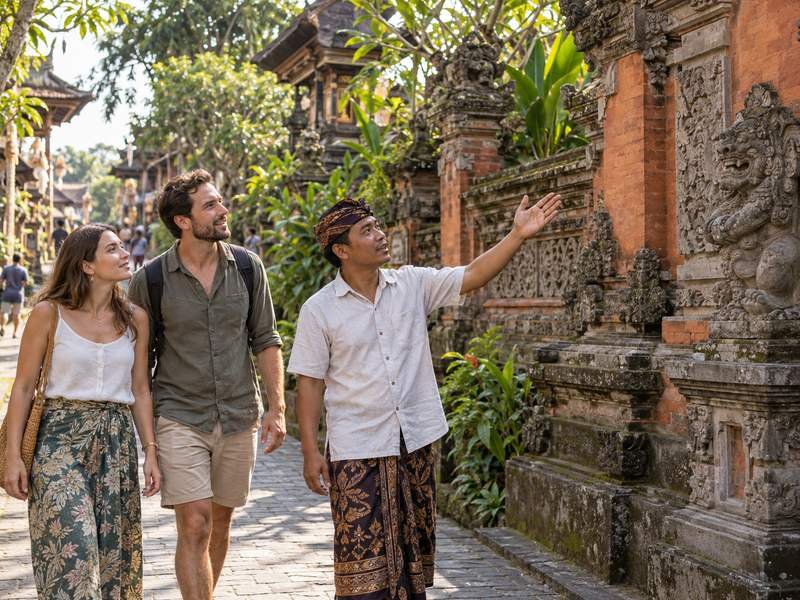
A guide can begin with that immediate situation. Which part are you looking at? What can you visit? We’d find those answers more useful at first than a long introduction delivered while everyone is still gathering at the entrance.
Then there’s room to look closer. A carved face might catch your eye, or the shape of a gateway might remind you of something you noticed earlier in Bali.
Now you’ve got a conversation.
That’s the kind of visit we’d discuss alongside the Ubud tour package. The route tells you where you’ll go, but it takes another conversation to establish who’ll accompany you inside and what they’ll help you understand.
We also appreciate a guide who leaves a little silence. Sometimes you’ve heard enough for the moment and simply want to look.
A guide and a driver have different jobs
The wording on a booking page can be confusing. “English speaking” sounds reassuring, but it doesn’t necessarily mean someone will explain an exhibition while standing beside you.
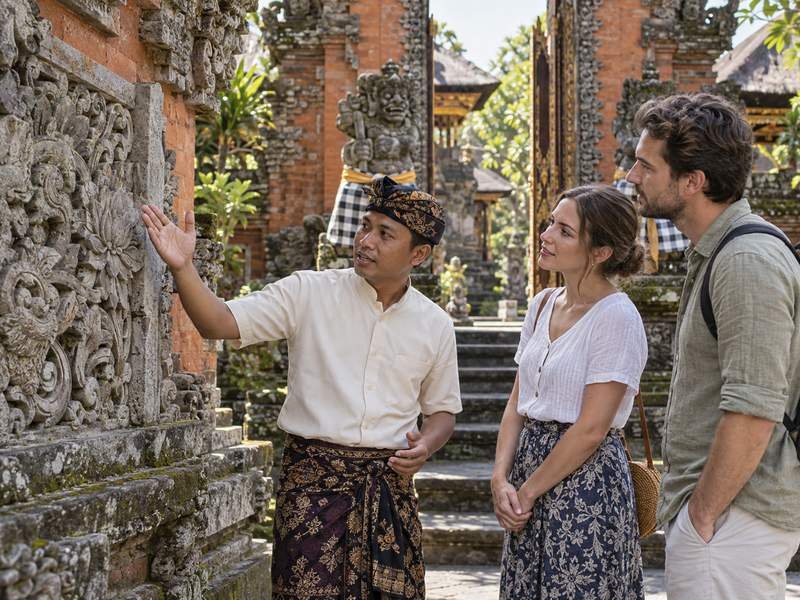
A driver handles the road journey. A guide interprets the places you visit and accompanies you through the agreed parts of the programme. One person can sometimes cover both roles, though we’d never assume that without discussing it.
The difference becomes obvious at an entrance. Are you walking in together, or arranging a time to meet again outside?
For someone seeking an Ubud guided tour, that’s a fairly important distinction. Neither arrangement is inherently wrong; the disappointment comes when you’ve booked one while expecting the other.
Ask which attractions include guiding inside. That one question gives the booking conversation a much clearer direction.
What you learn through Ubud’s art
Not everyone wants a museum morning. If you do, Museum Puri Lukisan gives you a place to explore Balinese painting and sculpture without having to turn the visit into a shopping trip.
We’d start with a single work.
That alone could give your Ubud guided tour a lovely focus.
Perhaps you notice several scenes sharing the same picture, and you’re unsure whether to follow them in a particular order. Perhaps it’s a tiny figure in the corner that interests you most.
Those are perfectly good questions. You don’t have to recognise a painting style before a guide can help you enjoy looking at it.
What we’d listen for is an explanation connected to the piece in front of you. After hearing it, can you see something you hadn’t noticed? That’s a better sign than how many dates someone can remember.
A little context can help with performance too. While discussing the Barong Dance Ubud tour, we’d establish which performance is proposed and whether an introduction to its characters is included.
After all, it’s easier to follow what’s happening when you have some idea who you’re watching. Nobody should expect you to arrive already knowing the story.

Rice terraces become more interesting with context
At Tegallalang, you’ll probably take the photograph first. So would plenty of visitors. The view is what brought them there.
Then you might notice water running beside a path. Follow that with your eyes for a moment and a different set of questions begins to appear.
Where is it going? How does it reach another plot?
A knowledgeable guide can use those observations to introduce Bali’s subak tradition of cooperative irrigation. We’d welcome an explanation that makes the cultivated landscape easier to read, without claiming to know the circumstances of every field below you.
The rice itself may look different from the image saved on your phone. Growing and harvesting change the appearance of the fields, so a photograph from another visit isn’t a promise of what you’ll find.
We’d use the Ubud travel guide while deciding how much countryside to include alongside central Ubud. Seeing where places sit in relation to each other helps avoid choosing stops purely because their photographs look good together.
And these are working landscapes. Knowing which paths welcome visitors is useful local context in its own right.
Choose stops that leave room for conversation
Three people can stand in the same museum room and want quite different things from it. One is reading every label. Another has found a favourite painting. The third is ready for some fresh air.
That’s normal holiday territory.
For us, an Ubud guided tour should allow some adjustment within the agreed programme. Otherwise, the explanations can become something to get through before everyone hurries to the next entrance.
Monkey Forest offers a different kind of attention. Here we’d value someone who helps you observe the macaques and understand the setting while following the site’s current visitor instructions.
No staged encounter needed. Watching from an appropriate distance can give you plenty to talk about, and a guide shouldn’t encourage an interaction simply because it might produce a photograph.
If you have only part of a day, we’d discuss the Ubud half day tour options around a clear interest. A focused visit leaves more room for questions than a route assembled to include every familiar attraction name.
There should be time to sit down too. Sometimes you only work out what you wanted to ask after you’ve left the gallery.

What we’d establish before booking
Your interests are a useful place to begin, even if they’re quite vague. “I like looking at buildings” tells us something. So does “we enjoy museums, but the children usually don’t”.
Walking comfort belongs in that conversation. An indoor visit and an outdoor path won’t suit every member of a group equally, and we’d prefer to discuss that while the programme is still taking shape.
Confirm whether attraction entry and any separate site guide are included. The proposed Ubud guided tour should also make clear where you’ll have an accompanying explanation and where you’ll be exploring independently.
When contacting Bali Prime Travel, you can begin with the thing you’re most curious about. There’s no need to send a finished itinerary; choosing suitable stops is part of the planning conversation.
Is a guided visit worthwhile if I’ve already been to Ubud?
It can be. Perhaps you visited a gallery before but left without understanding much of what you saw. We’d build on that curiosity rather than automatically repeat your previous route.
Can children enjoy the explanations?
Yes, though we’d keep them responsive. A short conversation about something a child has noticed is usually a better starting point than expecting them to listen through an adult explanation.
Do I need to know anything about Balinese art beforehand?
No. That’s a perfectly good reason to go with someone who can explain it.
Will the guide stay with us at every stop?
That depends on what you’ve booked. We’d settle it beforehand, because accompaniment inside an attraction is often what visitors have in mind when they request a guide.
Send Bali Prime Travel your travel date and the part of Ubud you’d like to understand better. Let us help you discuss an Ubud guided tour around that interest, with the guiding arrangements clarified before booking. One good conversation can be a lovely part of a holiday.